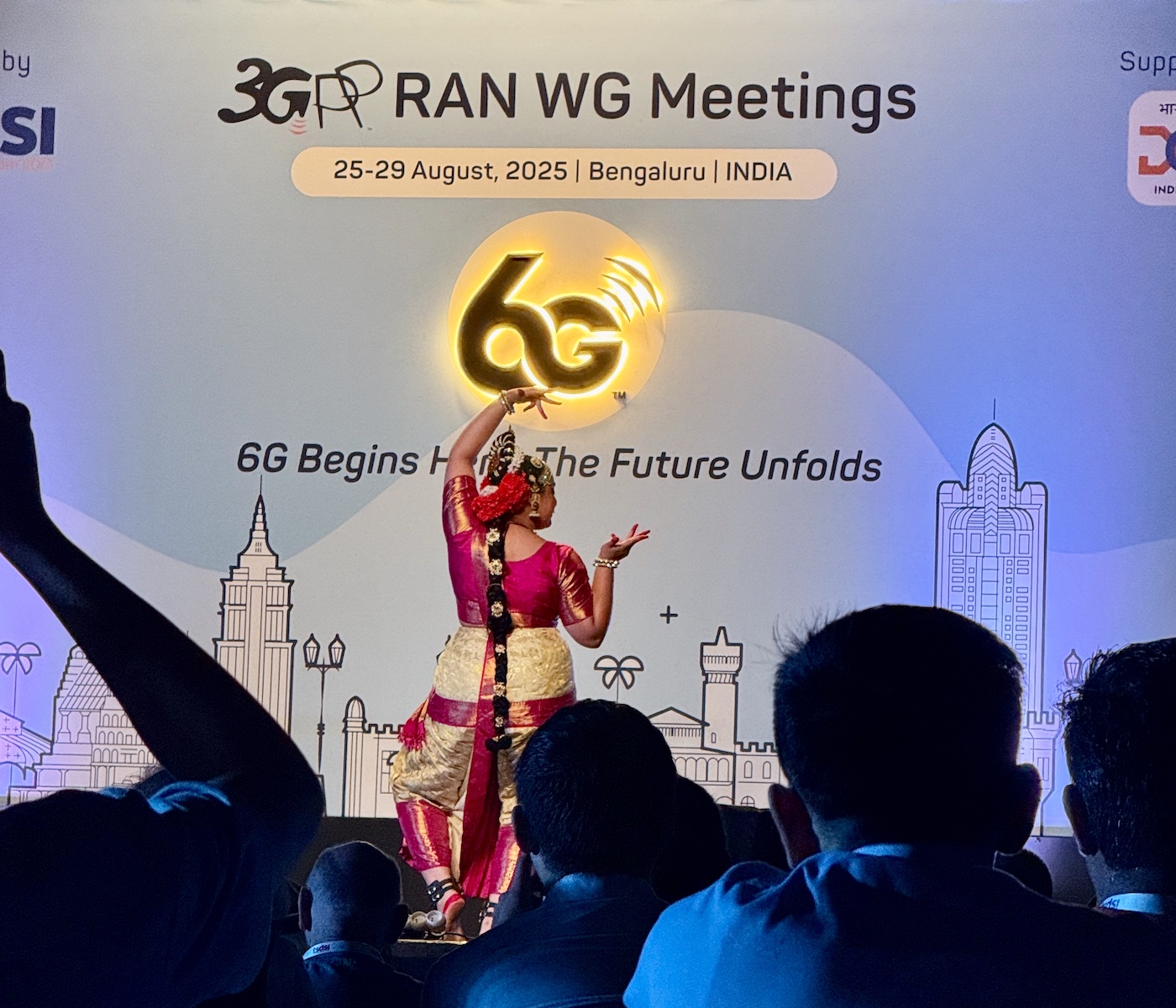
RAN Plenary meeting 109 (RAN#109) took place on September 15–18, 2025, in Beijing, China. Agenda Item (AI) 8 was devoted to the next wave of 6G work (the whole agenda is in RP-251911).
The spotlight was on the updates to 6G Scenarios and Requirements feeding into TR 38.914 that summarizes the outcomes of the RAN Plenary study of 6G. Alongside that, delegates dug into device types (how simple or capable different 6G devices should be), coexistence and spectrum use (how 6G fits with current bands and deployments), and early system design choices (numerology, bands, and other knobs that set the tone for performance and efficiency).
In other words: this meeting was less about flashy features and more about setting practical foundations—what to prioritize, how to keep devices lean, and how to transition from today’s networks without adding unnecessary complexity.
Chair notes and agreements can be found in the meeting report.
Below, you’ll find the exact agreements and the moderator summaries they come from, plus a short comment on each to make them easier to follow.
The spotlight was on the updates to 6G Scenarios and Requirements feeding into TR 38.914 that summarizes the outcomes of the RAN Plenary study of 6G. Alongside that, delegates dug into device types (how simple or capable different 6G devices should be), coexistence and spectrum use (how 6G fits with current bands and deployments), and early system design choices (numerology, bands, and other knobs that set the tone for performance and efficiency).
In other words: this meeting was less about flashy features and more about setting practical foundations—what to prioritize, how to keep devices lean, and how to transition from today’s networks without adding unnecessary complexity.
Chair notes and agreements can be found in the meeting report.
Below, you’ll find the exact agreements and the moderator summaries they come from, plus a short comment on each to make them easier to follow.
You can find the previous 6G agreement from RAN1#121bis in my earlier post.
Below are the main highlights of the revision:
As stated in RAN1 agreements, 6G study is required to “target scalable and forward compatible design for diverse device types”. There are two important aspects to be considered
The moderator frames Proposal 1 as setting the “floor” for 6G operation—first, by having RAN consider the minimum spectrum allocation (with RAN4 input), and second, by asking RAN1 to study a smallest maximum UE bandwidth for at least one low-tier FR1 device (options: 3/5/10/20 MHz, with FFS notes on UL≠DL, SCS/duplex/band, and RF vs. BB). The goal is to keep low-cost devices viable while preserving forward-compatibility, with company inputs invited for RAN#110 and a revisit planned there.
Proposal 3 & 4 are endorsed for RAN only (no WG discussion).
The moderator positions Proposal 3 as a scoping exercise to define a small, well-justified set of 6G device types, deciding whether to split eMBB vs. IoT and how (or if) to include categories like XR, FWA, wearables/RedCap, sensing, NTN, and AI/robotics. The emphasis is on forward compatibility and avoiding market fragmentation, with “device type” terminology itself open to refinement.
This agreement tasks RAN to pin down a compact, well-chosen set of parameters that characterize 6G device types (antennas, bandwidth, layers, duplex, modulation, CA, processing, coverage, energy, mobility, sensing/AI, etc.), noting where these tie to form factor. The next step is to assign concrete values per device type, balancing capability vs. cost/energy so the set stays focused and forward-compatible.
The following proposal was also discussed, but didn’t reach consensus offline:
The proposal explores creating a minimal baseline feature set that every 6G UE must support—ensuring interoperability and forward compatibility—while still allowing diversity across device types. It also leaves open whether some base-station functions should be mandated.
The agreements have been already achieved in RAN1 at RAN1#121bis with two aspects subject to RAN decision:
Basically, RAN just confirms the previous RAN1 agreements and leaves the further technical discussion to RAN1:
Other discussion topics without agreements included:
Currently, the SID includes an objective related to RAN security aspects as below:
RAN intentionally ring-fences RU as a logical entity and keeps the RU–DU/CU interface out of scope to avoid blocking progress on 6G RAN while the industry converges elsewhere (e.g., O-RAN vs. proprietary). That lets operators choose multi-vendor fronthaul or single-vendor stacks without 3GPP constraints, while RAN3 can still anchor the high-level architecture in TSxx.300/401.
Endorsed conclusions from slide 3 and 4:
Focus narrows to scenario evaluation for IMT-2030 and practical comparisons, with an explicit 15 GHz inclusion (non-rural) and ambitious antenna element caps for macro deployments. The not-yet-agreed parts roll forward to RAN#110 via RP-252915.
Also for UEs a wide range of antenna assumptions have been proposed from 1T1R to up to 32 antenna elements often depending on the band and device type. Device types were discussed separately (e.g., see above, eMBB, FWA, IoT, Automotive, etc.)
RAN discussed a number of deployments scenarios based on company proposals:
However, this work is considered to have lower priority than finalizing the updates for the existing scenarios, as also hinted in RP-252915.
Following proposals were agreed online and to be endorsed:
Energy efficiency becomes a formal 3GPP KPI; methodology points and power models are delegated to RAN1, and link-budget-based coverage evaluation is confirmed with targets TBD.
The agreements set a standalone 6G RAN with open interfaces, CP/UP split, and multi-TRP operation—explicitly supporting service awareness, higher resilience and lower cost—while ensuring coexistence with NR via inter-RAT mobility, Multi-RAT Spectrum Sharing, and UL/DL spectrum aggregation (including co-/non-colocated TRPs), plus NTN and non-public networks.
For migration, plenary will start studying any additional options in March 2026 and decide by September 2026 (TSG#113) whether to expand WG SIs; any normative work on migration (including 6G-6G DC) will be scoped later based on those study outcomes.
These proposals anchor Massive Communication in FR1 with a common, scalable 6GR design (eMBB-first) that deliberately avoids overlap with Ambient IoT and NB-IoT, while setting a one-antenna minimum for the lowest-tier IoT UE to keep cost and complexity down. Together, they aim to preserve a lean, forward-compatible baseline for low-end devices and make sure the device-type section of the TR captures these guardrails explicitly.
These proposals firm up a concise service set for TR 38.914 §5.4 (mobile broadband, immersive, Massive IoT, sensing, AI, voice, regulatory), keep several domains open for further discussion (NTN, aerial, FWA, vehicles, mission-critical, positioning/navigation, TSN, HRLLC), and ask 6GR to study concrete sensing modes (TRP/UE mono- and bi-static variants).
“Observability” here means making the RAN more inspectable and controllable—exposing timely, standardized telemetry and state (KPIs, events, intents, service context) so networks can troubleshoot faster, automate decisions, and enable closed-loop assurance.
Updates to the Study on 6G Radio (6GR) (8.2.2)
Revised SID
RP-252912.zip is the revised Study Item Description (SID) for the Study on 6G Radio.Below are the main highlights of the revision:
- The official acronym for the Study on 6G Radio is confirmed as FS_6G_Radio.
- In addition to the ongoing RAN plenary study on 6G Use Cases and Service Requirements (FS_6G-REQ), RAN will provide Stage-1 RAN-related requirements/KPIs to be taken into account in FS_6G_Radio as part of the continued study (FS_6G_RAN_Scen_Req).
- The RAN plenary will start the study of additional migration option(s) needed (other than standalone, MRSS, and inter-RAT mobility between NR–6G) in March 2026, and will make a decision by September 2026 whether to expand WG SI scope to cover additional migration option(s).
- See also the outcomes of AI 8.2.1.3 Requirements for architecture and migration.
- The corresponding milestone is added for TSG#113 (September 2026).
- The editors for the FS_6G_Radio TRs per WG are defined.
Device types
Source: RP-252873 — Summary of 6G diverse device types (incl. minimum UE bandwidth).As stated in RAN1 agreements, 6G study is required to “target scalable and forward compatible design for diverse device types”. There are two important aspects to be considered
- Smallest Maximum UE Bandwidth vs. Minimum Spectrum Allocation
- Whether or not to introduce baseline functionality mandatory for all 6G UEs
Proposal 1
- Endorse the following two RAN1 agreements (with the clarification that the 2nd agreement is applicable to FR1). Companies are invited to bring contributions regarding the minimum spectrum allocation in RAN#110, while RAN1 is requested to continue the study on both the minimum spectrum allocation and the smallest maximum UE bandwidth from the 6GR design perspective. Revisit in RAN#110.
- Agreement
- For the study of RAN1 6GR design, consider the minimum spectrum allocation in which 6G can operate, subject to further discussion and confirmation in RAN.
- Note: RAN4 involvement is necessary.
- For the study of RAN1 6GR design, consider the minimum spectrum allocation in which 6G can operate, subject to further discussion and confirmation in RAN.
- Agreement
- Study the following smallest maximum supported RF and BB UE BW without spectrum aggregation for at least one low-tier device type supported by 6GR framework from physical layer perspective, subject to further discussion and confirmation in RAN
- Opt1: 3 MHz • Opt2: 5 MHz • Opt3: 10 MHz • Opt4: 20 MHz
- FFS: UL bandwidth may differ from DL; values may depend on SCS/duplex/band; RF vs. BB BW may differ
- Study the following smallest maximum supported RF and BB UE BW without spectrum aggregation for at least one low-tier device type supported by 6GR framework from physical layer perspective, subject to further discussion and confirmation in RAN
- Agreement
The moderator frames Proposal 1 as setting the “floor” for 6G operation—first, by having RAN consider the minimum spectrum allocation (with RAN4 input), and second, by asking RAN1 to study a smallest maximum UE bandwidth for at least one low-tier FR1 device (options: 3/5/10/20 MHz, with FFS notes on UL≠DL, SCS/duplex/band, and RF vs. BB). The goal is to keep low-cost devices viable while preserving forward-compatibility, with company inputs invited for RAN#110 and a revisit planned there.
Proposal 3 & 4 are endorsed for RAN only (no WG discussion).
Proposal 3
- To investigate further:
- Motivations/justifications behind the proposed diverse device types, which should be a limited set
- Whether/how to have one or more device types for eMBB or 6G IoT
- Whether/how to have other device types for, e.g., XR/immersive experiences, FWA, VUE, wearables/RedCap, sensing, NTN-specific, AI agents, collaborative robots, etc.
- Whether/how to explicitly standardize device types
- Ensuring forward compatibility
- Minimizing/avoiding potential market fragmentation
- Note: the terminology “device type” is subject to further discussion and possible refinement.
The moderator positions Proposal 3 as a scoping exercise to define a small, well-justified set of 6G device types, deciding whether to split eMBB vs. IoT and how (or if) to include categories like XR, FWA, wearables/RedCap, sensing, NTN, and AI/robotics. The emphasis is on forward compatibility and avoiding market fragmentation, with “device type” terminology itself open to refinement.
Proposal 4
- In terms of diverse device types, study further:
- Possible parameters/factors, e.g.:
- Number of Tx antennas/chains
- Number of Rx antennas/chains
- Power classes
- Maximum UE bandwidth (DL/UL)
- Peak data rate (DL/UL)
- Maximum MIMO layers (DL/UL)
- Duplex mode
- Max modulation order (DL/UL)
- CA/spectrum aggregation (DL/UL)
- UE processing capabilities
- Coverage
- Energy efficiency
- Mobility/speed
- Sensing
- AI
- Note: some of the above parameters/factors may be related with form factor
- Note: aim to have a focused/limited set of parameters/factors for a device type
- Possible parameters/factors, e.g.:
- The value(s) for the identified parameters for a device type
This agreement tasks RAN to pin down a compact, well-chosen set of parameters that characterize 6G device types (antennas, bandwidth, layers, duplex, modulation, CA, processing, coverage, energy, mobility, sensing/AI, etc.), noting where these tie to form factor. The next step is to assign concrete values per device type, balancing capability vs. cost/energy so the set stays focused and forward-compatible.
The following proposal was also discussed, but didn’t reach consensus offline:
Proposal 2
- 6GR aims to specify a set of mandatory baseline functionalities for all UEs, with details to be further studied, by taking into account diverse device types for scalable and forward compatible design, and the requirements, as necessary, as in the 6G SID.
- Further study whether there is a need to mandate base stations for certain requirements/functionalities.
The proposal explores creating a minimal baseline feature set that every 6G UE must support—ensuring interoperability and forward compatibility—while still allowing diversity across device types. It also leaves open whether some base-station functions should be mandated.
System design aspects
Source: RP-252963 — Moderator's summary for 6G - system design aspects.The agreements have been already achieved in RAN1 at RAN1#121bis with two aspects subject to RAN decision:
- The first aspect is whether to consider 30 kHz or 7.5 kHz SCS for FDD band in addition to 15 kHz SCS, and
- The second aspect is whether to highlight some spectrum range and spectrum boundaries.
Basically, RAN just confirms the previous RAN1 agreements and leaves the further technical discussion to RAN1:
Agreement
- Regarding the RAN1 agreement below, the following is agreed:
- Keep using “around 7GHz” instead of using detailed frequency range definition in RAN1’s and RAN4’s study.
- 6GR takes the following SCS as start point for discussion for all the signals/channels except PRACH.
- For sub 6GHz
- The following subcarrier spacing is at least supported
- 15kHz SCS for FDD, 30kHz SCS for TDD
- FFS: 30kHz SCS for FDD for around e.g., 1–2.5GHz
- FFS: 7.5kHz SCS for sub1GHz (FDD)
Whether to discuss the FFS will be subject to RANP decision.
- The following subcarrier spacing is at least supported
- For around 7GHz
- The following subcarrier spacing options can be studied
- 30kHz, 60kHz
- The following subcarrier spacing options can be studied
- FFS: For around 15GHz
- The following subcarrier spacing options can be studied
- 30kHz, 60kHz, 120kHz
Whether to discuss it will be subject to RANP decision
- The following subcarrier spacing options can be studied
- For between 24.25GHz - 52.6GHz
- Subcarrier spacing 120kHz is supported
- FFS whether to allow using additional subcarrier spacing for SSB
- For sub 6GHz
- FFS subcarrier spacing for PRACH and up to initial access discussion.
Other discussion topics without agreements included:
- Numerology: companies expressed different interpretations of the objective specific to numerology in 6GR SID
- Numerology, avoiding multiple numerologies for the same band / sub-range (e.g., enabling synergies among frequency bands in the ~7GHz range)
- Spectrum: there are two controversial issues, for Terrestrial Networks (TN)
- Issue 1: How to categorize the frequency range? Should the spectrum resource from 7.125GHz to 8.4GHz be categorized into the lower group or the higher group?
- Issue 2: whether we need to highlight the specific 15GHz in the study or simply use a frequency range, e.g., Sub-24.25 GHz to cover 15GHz (Lower bound is dependent on the detailed definition of around 7)?
LS on Early Alignment on lower layer AS security aspects
Reference: RP-252891.zip — LS on Early Alignment on lower layer AS security aspects between RAN and SA.Currently, the SID includes an objective related to RAN security aspects as below:
- c) Access stratum (AS) security aspects, in alignment with requirements from SA3 [RAN2]
Way forward on fronthaul in 6G (8.2.1)
Source: RP-252881.zip — Way Forward on 6G Fronthaul 3GPP shall capture the following text in italic in a normative Annex of TSxx.401 or TSxx.300 (RAN3):
Note-2: This interface can be implemented according to e.g. (e)CPRI-based or fully proprietary solution(s)
- 6G NodeB architecture includes a distinct logical Radio Unit (RU).
- The functions hosted by the RU as well as the interface between RU and other parts of 6G NodeB are not specified in 3GPP.
Note-2: This interface can be implemented according to e.g. (e)CPRI-based or fully proprietary solution(s)
RAN intentionally ring-fences RU as a logical entity and keeps the RU–DU/CU interface out of scope to avoid blocking progress on 6G RAN while the industry converges elsewhere (e.g., O-RAN vs. proprietary). That lets operators choose multi-vendor fronthaul or single-vendor stacks without 3GPP constraints, while RAN3 can still anchor the high-level architecture in TSxx.300/401.
Study on 6G Scenarios and Requirements (FS_6G_RAN_Scen_Req)
Deployment Scenarios (8.2.1.1)
Sources:- RP-252914 — Moderator’s summary
- RP-252888 — pCR for TR 38.914 (Deployment scenarios)
- RP-252915 — pCR seed for further RAN#110 discussion
Endorsed conclusions from slide 3 and 4:
Slide 3
- For 6GR deployment scenarios focus on the following,
- analyze that the air interface design (aka “6GR”) to be developed during the 6G Radio Study fulfills the requirements of IMT-2030 (for the ITU process)
- analyze the performance of “6GR” in realistic/practical deployment scenarios and where applicable, allow comparison to 5G-Advanced
- Include carrier frequency of 15 GHz for the 6G scenarios (other than rural scenario) as part of 6G study.
- Note: Carrier frequency of 15GHz has not been confirmed by ITU-R/WRC
- Macro BS antenna elements
- Around 700 MHz: Up to 64 Tx and Rx antenna elements
- Around 2 GHz: Up to 288 Tx and Rx antenna elements
- Around 4 GHz: Up to 576 Tx and Rx antenna elements
- Around 7 GHz: Up to 2304 Tx and Rx antenna elements
- Around 15 GHz: Up to 2304 Tx and Rx antenna elements
- Around 30 GHz: Up to 4096 Tx and Rx antenna elements
- Note: Mapping between TX / RX antenna elements and TX / RX ports will be discussed in RAN1
Focus narrows to scenario evaluation for IMT-2030 and practical comparisons, with an explicit 15 GHz inclusion (non-rural) and ambitious antenna element caps for macro deployments. The not-yet-agreed parts roll forward to RAN#110 via RP-252915.
Also for UEs a wide range of antenna assumptions have been proposed from 1T1R to up to 32 antenna elements often depending on the band and device type. Device types were discussed separately (e.g., see above, eMBB, FWA, IoT, Automotive, etc.)
RAN discussed a number of deployments scenarios based on company proposals:
- Urban Grid (Subchapter existed → details proposed) (RP-252001, RP-252218, RP-252127, RP-252177, RP-252470)
- Highway (Subchapter existed → details proposed) (RP-252218, RP-252127, RP-252177, RP-252470)
- High Speed (train) (Subchapter existed → details proposed) (RP-252121)
- Single cell with large coverage (RP-252118)
- Indoor Factory (InF) (RP-252118, RP-252127, RP-252021, RP-252581)
- UAV (RP-252126)
- Multi-layer heterogeneous network with assisting node (RP-252021)
- Nearshore water (RP-252021)
However, this work is considered to have lower priority than finalizing the updates for the existing scenarios, as also hinted in RP-252915.
Key performance indicators (8.2.1.2)
Sources:- RP-252883.zip — Moderator's summary for RAN led 6G SI: Key performance indicators
- RP-252947.zip — pCR for 38.914 on Key performance indicators for 6G
- This contribution gives text proposal for TR 38.914 V0.1.1 on key performance indicators (KPIs) based on the latest ITU working document “Working Document towards a Preliminary Draft New Report ITU-R M. [IMT-2030.TECH PERF REQ]: Minimum requirements related to technical performance for IMT-2030 radio interface(s)”
Following proposals were agreed online and to be endorsed:
Proposals (KPI)
- Proposal 1: For 3GPP internal evaluation, define energy efficiency as a quantitative KPI in 3GPP for both network and device.
- Proposal 2: For 3GPP internal evaluation, at least empty load and partial load cases should be evaluated in 6GR study.
- Evaluate via system level simulations (SLS)
- Other evaluation methods are not precluded when relevant
- Proposal 3: For 3GPP internal evaluation, UE/network power model is to be discussed in RAN1.
- Proposal 4: For 3GPP internal study, link budget is used as the evaluation methodology for coverage when applicable
- Proposal 5: For 3GPP internal study, the target for coverage is to be determined by RAN.
- FFS: Exact coverage target value(s).
- FFS: Additional details considering control/data channel
Energy efficiency becomes a formal 3GPP KPI; methodology points and power models are delegated to RAN1, and link-budget-based coverage evaluation is confirmed with targets TBD.
Requirements for architecture and migration (8.2.1.3)
Sources:- RP-252909.zip — Moderator's summary for RAN led 6G SI: Requirements for architecture and migration
- RP-252870.zip — pCR for 38.914 on Requirements for architecture and migration for 6G
Agreements — Requirements for architecture and migration
- The 6G RAN architecture shall support standalone RAN architecture.
- The RAN architecture shall support connectivity through multiple TRPs, either collocated or non-collocated.
- 3GPP defined interfaces for 6G RAN shall be open for multi-vendor interoperability.
- The 6G RAN architecture shall allow for control plane and user plane separation.
- The 6G RAN architecture shall support sharing of the RAN between multiple operators.
- The 6G RAN architecture shall allow for the operation of network slicing.
- The 6G RAN architecture shall be designed considering both terrestrial network and non-terrestrial network.
- The 6G RAN architecture shall support inter-RAT mobility between the 6GR and NR.
- The 6G RAN shall support Multi-RAT Spectrum Sharing between 6GR and NR.
- 6G RAT shall support Spectrum Aggregation (e.g. Carrier Aggregation) for both uplink and downlink, and for both co-located and non-co-located TRPs.
- 6G RAN architecture shall support enhanced service awareness in RAN.
- The design of the 6G RAN shall allow enhanced resilience compared to NR if/where applicable.
- The design of the 6G RAN shall enable lower CAPEX/OPEX with respect to current networks.
- The 6G RAN architecture shall allow non-public network.
- RAN plenary start study in March 2026
- RAN plenary study if any additional migration option(s) is needed (other than standalone, MRSS, and inter-RAT mobility between NR-6G)
- RAN plenary to make a decision by September 2026 whether to expand WG SI scope to cover additional migration option(s)
- Scope of normative work on migration functionalities functionalities to be done upon WG work item scoping.
- Same applies to 6G-6G DC
The agreements set a standalone 6G RAN with open interfaces, CP/UP split, and multi-TRP operation—explicitly supporting service awareness, higher resilience and lower cost—while ensuring coexistence with NR via inter-RAT mobility, Multi-RAT Spectrum Sharing, and UL/DL spectrum aggregation (including co-/non-colocated TRPs), plus NTN and non-public networks.
For migration, plenary will start studying any additional options in March 2026 and decide by September 2026 (TSG#113) whether to expand WG SIs; any normative work on migration (including 6G-6G DC) will be scoped later based on those study outcomes.
Requirements of new and existing services (8.2.1.4)
Sources:- RP-252943.zip — Moderator's summary for RAN led 6G SI: Requirements of new and existing services
- RP-252960.zip — pCR for 38.914 on Requirements of new and existing services for 6G
Endorsed proposals
- Proposal 1:
- 6G Massive Communication (IoT) shall be supported for FR1.
- 6GR should have a common/scalable design that supports the above usage scenario in addition to eMBB
- Prioritize 6GR design for eMBB
- The above usage scenario should not overlap with Ambient IoT and NB-IoT
- 6GR should have a common/scalable design that supports the above usage scenario in addition to eMBB
- 6G Massive Communication (IoT) shall be supported for FR1.
- Proposal 2:
- For 6G Massive Communication (IoT), the minimum number of UE receive/transmit antenna is 1 for lowest-tier device
- Reflect this agreement in the device type section of the TR
- For 6G Massive Communication (IoT), the minimum number of UE receive/transmit antenna is 1 for lowest-tier device
These proposals anchor Massive Communication in FR1 with a common, scalable 6GR design (eMBB-first) that deliberately avoids overlap with Ambient IoT and NB-IoT, while setting a one-antenna minimum for the lowest-tier IoT UE to keep cost and complexity down. Together, they aim to preserve a lean, forward-compatible baseline for low-end devices and make sure the device-type section of the TR captures these guardrails explicitly.
Endorsed Moderator's proposals
- Moderator proposal 1:
- It is agreed to capture following into TR 38.914 section 5.4:
- Mobile broadband
- Immersive Communication
- Massive Communication (IoT)
- Sensing
- AI
- Voice
- Regulatory services
- It is agreed to capture following into TR 38.914 section 5.4:
- Moderator proposal 2:
- It is agreed that ‘Observability’ will be discussed in architecture requirements.
- Moderator proposal 3:
- Whether to capture following into TR 38.914 section 5.4 will be further discussed:
- Non-Terrestrial Network
- Aerial
- FWA
- Vehicles
- Mission Critical Communication
- Positioning and/or Navigation
- TSN
- HRLLC
- Whether to capture following into TR 38.914 section 5.4 will be further discussed:
- Moderator proposal 4:
- 6GR should study the sensing modes, including TRP monostatic, TRP-TRP bistatic, TRP-UE DL, UE-TRP UL, UE-UE bistatic and UE monostatic.
These proposals firm up a concise service set for TR 38.914 §5.4 (mobile broadband, immersive, Massive IoT, sensing, AI, voice, regulatory), keep several domains open for further discussion (NTN, aerial, FWA, vehicles, mission-critical, positioning/navigation, TSN, HRLLC), and ask 6GR to study concrete sensing modes (TRP/UE mono- and bi-static variants).
“Observability” here means making the RAN more inspectable and controllable—exposing timely, standardized telemetry and state (KPIs, events, intents, service context) so networks can troubleshoot faster, automate decisions, and enable closed-loop assurance.